
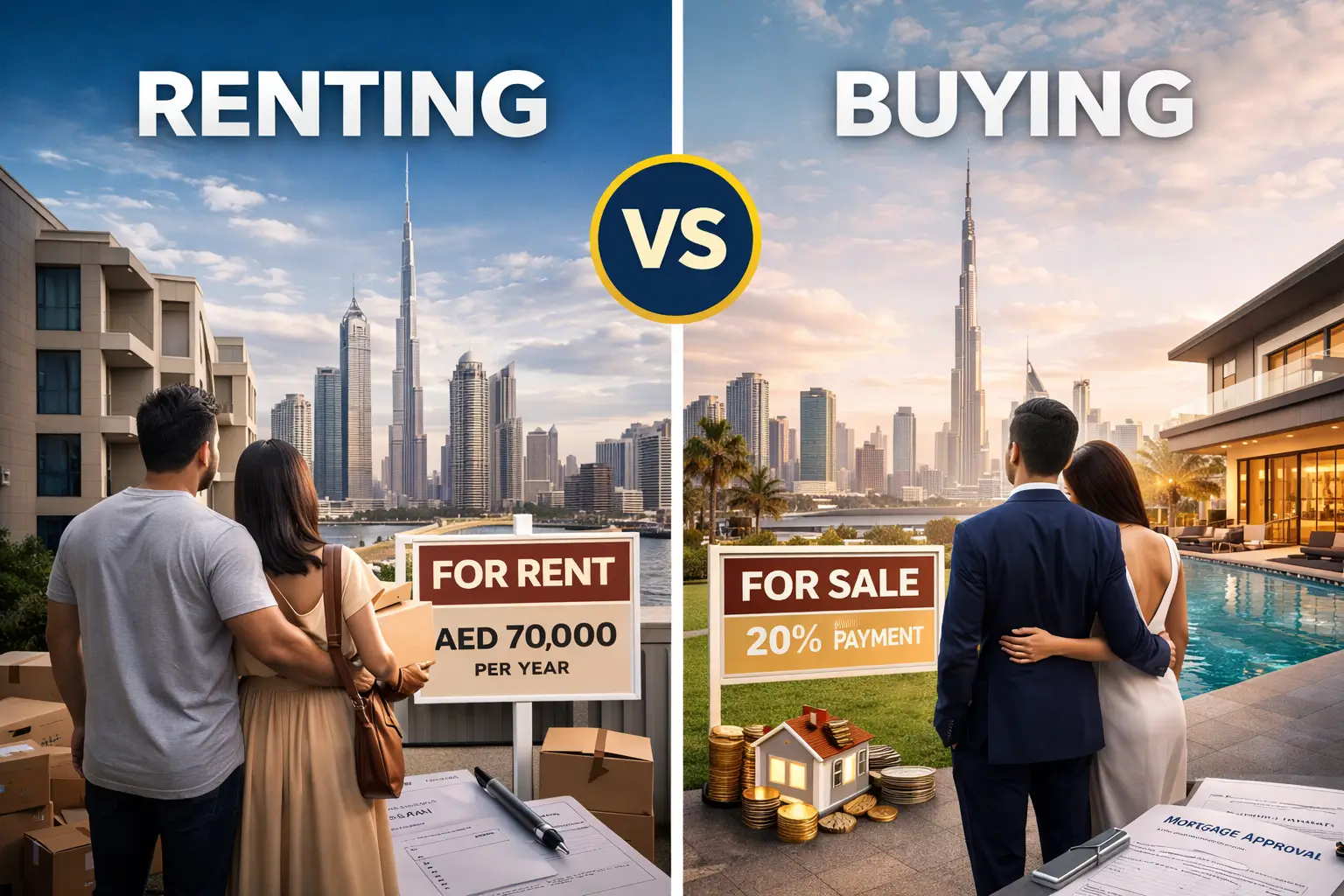
In Dubai, the choice to rent or buy hinges on a few key levers. It is more about how long you’ll stay, how much cash you can commit upfront, your monthly affordability if rates shift, and whether you’d rather keep life flexible or start building equity. This guide trims the noise for you to better understand the numbers and trade-offs that actually move your decision. Let’s see, which path protects your cash today and grows your net worth tomorrow?
If you’re looking for a quick answer, then here it is. You should rent if you’re unsure about staying around 3–5 years, want low upfront costs, and value flexibility. But you should buy if you can comfortably afford the ~20% down payment and plan to stay 5+ years.
Here is a clear breakdown of what it really costs to get started upfront.
Renting vs Buying in Dubai: Cost Breakdown
Renting (Typical 1-Bedroom Example)
If the annual rent is around AED 70,000, your initial upfront cost usually falls in the mid–20,000s AED range (including deposit, agency, Ejari, and first payment).
- Security Deposit: ~5% of annual rent (refundable if no damages)
- Agency Fee (if applicable): ~5% of annual rent
- Ejari Registration: ~AED 220 (+ small typing/service fee)
- First Rent Payment: Depends on cheque structure (monthly, quarterly, or annual)
Buying (Same City — Very Different Math)
Purchasing property in Dubai involves significantly higher upfront costs. Here’s a typical breakdown:
- Down Payment (Expat Buyers):
- ~20% (for properties up to AED 5M)
- Higher for properties above AED 5M
- DLD Transfer Fee:
- 4% of property price
- ~AED 540–580 admin fee
- 4% of property price
- Trustee Office Fee: ~AED 2,000–4,000
- Mortgage Registration (if applicable):
- 0.25% of loan amount
- AED 290
- 0.25% of loan amount
- Agency Fee:
- ~2% of purchase price
- 5% VAT
- ~2% of purchase price
- Bank / Valuation / Processing Fees:
- Typically a few thousand AED each
Flexibility vs commitment
2024 saw strong rental and price growth. But in 2025, the market remained active but more balanced. Selling in popular communities like Dubai Marina or Business Bay was quick, while newer suburbs took longer. Renting has more flexibility, like one-year contracts being standard. Moving areas or exiting Dubai after a project/contract is simpler. Buying is like a commitment. Exiting means marketing the property, waiting for transfer, and covering costs. Remember, resale time varies with market conditions.
Expense vs investment
Rent is a pure expense, which is great for flexibility, but it builds no asset. Buying channels part of your monthly payment to the principal, slowly building equity. Dubai’s advantage lies in no annual property tax and no income/capital gains tax on individuals. Additionally, property investment can unlock residency opportunities like Property Investor Visa (2–3 years) with min. AED 750,000 property value. Golden Visa (10 years) of min. AED 2,000,000 property value.
The 5 Year Plan
To make this decision tangible, compare the total 5-year cost of both paths:
- Rent path: Rent × 5 years + broker fee + Ejari renewals.
- Buy path: Upfront (down payment + DLD 4% + trustee + agency + mortgage reg + valuation/bank fees), Ongoing (EMIs (principal + interest) + service charges (AED/sq.ft varies) + maintenance).
Now estimate your equity built (the portion of EMIs paying down principal) and any expected appreciation (±5–10%). If you’re buying purely for investment, also weigh rental yields, Dubai averages 5–8% gross, depending on area and property type.
Area-wise budget fit
For renters, Al Nahda, International City, Discovery Gardens, parts of JVC, and Dubai Silicon Oasis offer more affordable rents. For buyers, JVC, Dubai South, DSO, Town Square, and some Dubailand communities have lower entry prices and strong new development activity. Always check RERA’s Rental Index and a building’s service charge rate to compare total housing costs.
Real-world profiles
If you’re new to Dubai, renting will help you keep the cash flexible and explore neighborhoods. If you have a family with long-term plans of almost 5–10 years, it’s better to buy. It is more stable, with predictable costs, and potential appreciation outweighs the higher upfront hit. If you have an investor mindset, buying is a good option. So, choose areas with high occupancy and solid net yields. If you’re a freelancer or contract-based expat, then renting will avoid long-term financial lock-in until your income stabilizes.
Key numbers to sanity-check
Before buying, ask for the property’s latest service-charge statement and check if your mortgage has a fixed or variable rate. This can change your long-term affordability. Here are some key numbers to check before you decide:
- Down payment (expat): 20% up to AED 5M (then 35%+); 15% for UAE nationals.
- DLD fee: 4% of price (+ ~AED 540–580 admin).
- Mortgage registration: 0.25% of the loan + AED 290.
- Agency fee: around 2% (+ VAT).
- Ejari: ~AED 220.
- Service charges: differ by building—usually AED 10–25/sq.ft yearly.
Market pulse in 2025
Dubai’s 2025 market is seeing steady demand but more segmentation. Zee Real Estate experts have already made their place in the real estate market with their market insights that will help you achieve your goals. Balancing out rental inflation. If Dubai is a multi-year plan and you can comfortably afford the full cost of ownership, buying can grow your wealth and give you stability. If your stay or cash flow is uncertain, renting keeps life flexible and risk-free.




Join The Discussion